Monday, October 6, 2014

Running for Good


Dare I say it? I’m a runner. I don’t know when it happened.  I have run off and on for exercise over the last 10 years but never with any consistency.  Whenever I’d spend a few weeks getting going, I’d find a reason to miss some runs and before I knew it, I was out of the habit.  Last summer I did some running but it was always in spurts.  But this summer I’ve been running with more consistency than ever before. I can’t believe this, but I’m actually starting to really like it. It feels good to have some soreness in my legs all the time, and I love to push for faster and farther runs. After a few 5K’s and a 10K, I’m signed up and ready for my first half marathon on October 11th. (Pray for me.)

Recently I was on a long run training for my half marathon and I was struck by an idea. I was running 14 miles around and through Mount Pleasant, beginning on county highways.  With no real space for pedestrians, I was running against traffic forcing many of them to go wide around me.  As I did, I found myself waving to each passing car, knowing that I was imposing on their normal driving space and trying to acknowledge their kindness in not running me over. 

I don’t know if it was the voice of the Spirit or if two hours of running is just too long for me to remain focused on the music in my ears, but I began to recognize as cars and houses passed me that each one contained people created by and loved by God.  Someone should be praying and offering a blessing to these strangers on my route. Finally it clicked and my run became a prayer run. My waves at passing cars instead became a prayer of blessing and a motion of the cross towards them. I began to pray for the people living in the homes and neighborhoods I passed, knowing that God would know their needs even if I don’t.

Then I had a thought. What if I started doing this on every run? What if I did it while driving through town. What if we all did? I can’t claim to fully understand how intercessory prayer and blessings work. But it’s clear that we are told to pray for others and there are people throughout our communities that are in need of God’s touch on their lives. What if we were a church that prayed for those we saw in passing?

Here’s what it did for me while running:
· It helped me to notice.  Before I was oblivious to the people I encountered on my run; instead paying attention to myself alone. In prayer, I noticed every house, every car, every pedestrian.
· It eased my anger at those texting and driving. After some close calls on the highway while drivers didn’t see me cause their eyes were on their phones, I was pretty mad. My prayer running allowed me to instead see them with love.
· It reminded me that I don’t pray enough. As a follower of Jesus and as a pastor, I should be connected to God in prayer more than I’m connected to the internet. I need an “always on” connection like my phone has through its cellular network.

So what do you think? Want to be a prayer-runner with me? Or prayer-walker? Or prayer-driver? Imagine what God will do in our community when we pray.


On the move

I'm still flying high from yesterday.  What a great day we had as we worshiped together on our newly poured concrete parking lot, dedicating it to the work of the Kingdom.  We prayed, we sang, we wrote blessings in sidewalk chalk.  The cold wind and sprinkles of rain gave way to sunshine and warmth all in the course of an hour of celebration.  I can't remember a better Sunday.

But that may be a problem.

Preparing for this Sunday worship was a joy.  I was excited that we were taking a risk and doing something different.  And believe me, everything about this was a risk.  First, we took a risk by choosing to take on a parking lot restoration project that cost more than our yearly budget.  (A yearly budget that we are often behind on, by the way.) And we didn't just decide to raise the money, we had the construction company start the work.  Talk about risk.  We aren't one of those churches that complains about being behind financially while sitting on an endowment or large savings that no one wants to touch.  We have what is provided by those that give in faith every Sunday.  And we cut it pretty close sometimes.  The parking lot was a risk, but in a matter of a few months, the work is done and as of yesterday, all $157,000 has been raised through donations, gifts, and pledges to be paid over the course of a year.  God is faithful.

The parking lot was a risk, not just financially, but in regards to following God's plan for our church.  I didn't even want to do the thing.  I couldn't wrap my head around putting an unbelievable amount of money into the place that we park our cars.  Aren't there other places we could invest that kind of money that would be more in line with our call as a church? But the reality was that it had to be done. We didn't have potholes, we had craters two feet deep and ten feet long.  Someone was going to be hurt or a car was going to disappear into the underworld.  But would God bless the use of money for something such as this? We had all the conversations and ultimately had to make a choice.  Like Jonathan and his armor bearer, we decided to push forward and know that if it was a success, then God was on our side.

Our Parking Lot Worship was also a risk. When I shared with our church that we were meeting outside for the entire service in October, there were some skeptical faces.  Thankfully, this isn't the first time I've asked people to do something weird.  After all, not that long ago, we left worship on a rainy September Sunday to take "Christian toilet paper" door to door and pray for those we encountered.  This seems tame by comparison, but the cold can cause some problems.  My first conversation of the day as I was setting up outside and the first people were coming for Sunday School went like this: Senior Adult: "Are we still having church outside?"  Me: Yep, it'll be brisk."  Her: "Well, I have a coat."  It was a great way to start our day. I didn't encounter someone complaining about the cold, but ready for what God had in store for us.

And Parking Lot Worship really was awesome. But what about the rest of our weeks in worship?  I have to admit something here that's hard to admit as a pastor.  I don't always get so excited for a Sunday morning.  Actually, between you and me, I sometimes dread them. Yes, I know, I should love to come together with our church to worship; and in a lot of ways I do. But it's also a stressful day full of work and pressure to lead the time together. I want the music - that I help lead - to usher people into God's presence.  But I also want it to sound good. I want my sermon to help people to grow closer in their relationship to Christ.  But I also don't want to sound like an idiot.  Every week I fight through my challenges to try to be the leader I'm called to be among God's people.

I think maybe it comes down to one thing.  I'm super excited when I can see and feel God moving.  And I wonder how many Sundays out of the year our churches can say that is really happening.  Rev. Eddie Cruz was our speaker at the Mid-American Baptist Churches Biennial this weekend and something he said speaks directly to this. He told of an encounter he had with some young adults who had little interest in church.  They told him the typical responses: it's boring, it isn't relevant.  It's like going to a funeral.  He then reminded us that there are great celebrations that we see around us.  In celebrity culture there are Grammys, Espys, Oscars, Emmys, etc, and what do those people have to celebrate other than their own accomplishments?  But we have a God and a Gospel that give us a reason to celebrate. With that to celebrate, how could our gatherings look more like a funeral than a celebration?

I need to get excited about every Sunday because it is a celebration of the God of the universe who gives us life in Jesus Christ. It shouldn't take doing something crazy to be excited.

So what do you think? How do we as the church make every time we gather in Christ's name a time where we see and feel the movement of the Spirit?

Cause I'm up for feeling like this every week.


Monday, June 16, 2014

Won't you be my neighbor?

The other day through the wonders of online streaming video, I had the opportunity to introduce my boys to Mister Rogers' Neighborhood.  They didn't quite get it, I don't think, but I got to reminisce a bit watching this show from my childhood.  And of course it helps knowing that Fred Rogers was truly an exceptional man.  He was a Presbyterian minister and spent over 30 years treating America's kids as neighbors, teaching them values, and show them how to use their imagination. 

What struck me as I watched the show again, was how Mister Rogers invited you right into his "house" while singing the famous song and changing his suit jacket to a sweater and dress shoes for casual ones.  I wonder how often I even treat my own kids with that kind of warmth as soon as I walk in the door after work, let alone random kids and neighbors.  Mister Rogers knew hospitality.

But I think - and I can only guess - that when Mister Rogers' show began in 1968, a neighborhood meant something.  Being a "neighbor" was a term of endearment that meant that you were friendly and welcome.  Neighbors helped look after each other; keeping an eye out for your house when you were gone, making sure your kids weren't getting into trouble, and sharing a cup of sugar when you ran out.  At least that's the stereotype that I imagine when I think of neighbors before my generation. 

Someone noted at a recent MCLE (Missional Church Learning Experience) gathering that people used to sit out in their rocking chairs on the front porch engaging with their neighbors.  Now we build 6 foot high privacy fences and back decks so we can sit outside and talk to no one.  It's unfortunate that we've lost the ability to be neighbors.

We're trying to change that at First Baptist Church of Mt. Pleasant.  In June, we had 6 "hosts" reach out to their neighbors with an invitation to relationship in exciting ways.  Five of those hosts invited their neighbors to block parties at their homes, hosting food and conversation for neighbors The results were amazing, as each party had many guests and created opportunities to get to know neighbors like never before.  Personally, I felt like we just gained a neighborhood after eight years of living in this house.  Who knew we were surrounded by such kind and fun people?  The other "host" instead baked pies and delivered them to her neighbors as a gift.  Again, this was well received by those in her neighborhood.

And here's the fun part.  A few days ago, while outside spraying for weeds, one of my new neighbor friends yelled over from across the street.  We met in the middle and chatted for a few minutes and again, I was reminded that this is what a neighborhood is.  And this is what Jesus commands us to do; to "love your neighbor as yourself". 

Doing this also reminds us that we are not a church by showing up for an hour a week to worship together.  Yes, that's important, but we are God's church when we follow His commands.  As Rev. Glynis LaBarre said, "Jesus did not die to save your church.  He didn't even die to save THE Church.  The Church exists to carry out His mission."  When we get outside our building and live among and love our neighbors, we begin to be who God has made us to be.

I get excited when I imagine a church of people living in Mount Pleasant, the surrounding countryside, and neighboring communities as far as Fairfield and Waterloo living out a love for their neighbors.  Imagine the reach that the Kingdom has if we go and love our neighbors and live as witnesses to the grace and peace that comes from a relationship with Jesus.

Lord, build Your Kingdom here,
Regan


Wednesday, June 11, 2014

Team Umizoomi, ready for Baptism

My 3 year old son, Hayden, loves Team Umizoomi!  I mean, loves that show.  Whenever he wakes up in the morning or from his nap, his request is well known by all around.  Turn on Team Umizoomi.  Hayden can also answer questions about Jesus like a champ.  If you ask where Jesus lives, he'll answer confidently, "In my heart."  If you ask who made the grass, world, or us; he'll answer, "Jesus" or "God" without skipping a beat.

So shouldn't he be baptized?  Has he "asked Jesus into his heart", "prayed a prayer of salvation" or "gotten saved"?  NO!  He's three.

I read an article recently on Christianity Today stating that in the Southern Baptist Convention, baptisms are dropping off at a record level for all but preschool aged kids.  You can read the article here.  This is alarming to me.  I'm not that worried about Southern Baptist general baptisms, but I am concerned about the growing practice of baptizing children before they're capable of making a commitment for Christ.

Is this weird coming from the guy who just wrote a post about allowing children to join us in Communion?  Maybe.  But as a Baptist, I see baptism as a profession of our faith that represents a lifelong commitment to Christ, and I'm not sure that's something a preschooler can make.  (Communion, on the other hand, is a practice of the presence of Christ and He consistently called children to Himself while on earth.)

According to Piaget's stages of brain development, children don't have the ability to think  concretely until ages 7-12 and don't usually begin to develop the capacity for abstract thinking until around age 12.  Many are still developing abstract thinking well into their 20's.  I don't know about you, but being able to understand cognitively that there is an invisible God who created the universe, is Trinitarian, and sent Himself/His Son to earth to die on the cross as atonement for our sins and raise from the dead requires a bit of abstract understanding.  

And it makes me wonder if the reason we're losing our young people as they acquire the ability to think abstractly and are challenged by the world, is because we push them to make commitments they can't cognitively make when they're younger.  So they abandon what they were taught because it all seems like it was forced, and now they are trying to come to terms with it all.

The truth in my family is that all three of my boys could answer the questions right; especially if I asked the questions in the right way.  My 5 and 7 year olds could even tell you that they love Jesus and know He is an important part of their lives.  But that's because we have taught them those things.  And on their level, they really do believe them.  (Of course, they believe in Santa Claus, the Tooth Fairy, and that they can be super heroes when they grow up too.)

So be careful, parents, pastors, Sunday School teachers.  The only good you are doing by pushing your child to "get saved" and be baptized at an early age is to make yourself feel better.  But are you willing to do that at the expense of a real commitment?  I'm not.  I'm not, because I get to walk with teenagers and adults as they actually go through this struggle to faith on their own and see that true commitment is worth waiting for.

What do you think?

Monday, June 2, 2014

Is it time to rethink how we treat kids and Communion?

Let's get this out of the way; I'm an American Baptist and have been my whole life.  I recognize my thinking is going to be out of traditional ABC church practice, and definitely outside other church traditions.  So just know where I'm coming from.

I think it's time to let children join us in Communion (or Lord's Supper, or Eucharist, or The Table).  

Growing up in ABC/USA churches, I learned that Communion was an ordinance of the church that we began to partake of after our baptism.  There were a few exceptions like Christmas Eve or Maundy Thursday, when I got to take the elements with my family, but otherwise I waited till after my baptism at 8 years old.  It was only then that I was ready to understand and take the bread and juice that represent Jesus' body and blood.

And I get it.  I do.  After all, 1 Corinthians 11:27-29 says, "So then, whoever eats the bread or drinks the cup of the Lord in an unworthy manner will be guilty of sinning against the body and blood of the Lord.  Everyone ought to examine themselves before they eat of the bread and drink from the cup.  For those who eat and drink without discerning the body of Christ eat and drink judgment on themselves."  So we make sure that we take seriously the taking of Communion and keep children from it until they can take it seriously.  (Though our 'age of accountability' is open for interpretation and many still may not be able to grasp its seriousness after baptism.)

But I've been challenged to understand Communion differently lately and it's affecting much of how I've been practicing it.  I've always struggled with Communion because I didn't really understand it.  As Baptists, we tend to see the bread and juice as symbols of the body and blood of Jesus, and let it simply serve as that tangible reminder of Jesus' sacrifice for us.  But I've been challenged by teachings by Dr. David Fitch from Northern Seminary and by conversations with other pastors - like my dad - that there is more happening at The Table.  As you read through the New Testament post resurrection, it seems that the "breaking of bread" brings more than remembrance; but the acknowledgment of the presence of Christ into the mix.

My favorite example happens right after the resurrection as Jesus walks the road toward Emmaus with two followers who don't recognize Him; even telling Him about His own death.  Even as Jesus unpacks the Scriptures, they don't know that it's Him.  But when they arrive at their destination and Jesus breaks bread with them, they realize that it is the risen Christ with them.  There must be something significant about eating together that allows Jesus' presence to be tangibly known.  

That brings me to the issue of children in worship.  I have three boys and we found pretty early on that Communion would be a challenge with our oldest when he started sitting with my wife in worship.  When the time came for bread and juice to be passed around, he didn't understand why he wasn't included.  My wife quickly came to the conclusion - out of a desire to eliminate distractions - that our 4 year old would receive it too.  (I know; sacrilege.)  And I agreed with her.  But each month on the first Sunday as we prepared to pass out the elements, she would talk with my son about the significance of the bread and juice.

As you can imagine, some didn't like it.  And we didn't really start this because of some deep theological understanding of Communion that differed from our congregation's traditions.  It was just a desire to not have the pastor's son cry loudly from the second pew during Communion.

But all that has changed.  This question of Communion and kids has reminded me of another passage of Scripture.  Matthew 19:13-14 says, "Then people brought little children to Jesus for him to place his hands on them and pray for them. But the disciples rebuked them.  Jesus said,  'Let the little children come to me, and do not hinder them, for the kingdom of heaven belongs to such as these.'" (emphasis mine.)

So if Communion is truly what the word means; a close intimate fellowship with another - namely Jesus - then we are in the same situation.  At The Table, our children could be exposed to the presence of Christ while we, like the disciples, tell them to "get away.  The presence of Jesus is no place for children."  

So maybe it's time to really rethink how we deal with this issue.  Are kids sometimes irreverent?  Yep.  Were they probably irreverent when they came to Jesus as the gospel stories tell?  Yep.  

And to be clear, the 1 Corinthians passage used to put kids off wasn't written to deal with children and Communion, but to adults who were refusing to reconcile their relationships or live in communion with one another.  Paul wasn't talking to children at all.  But we adults better be careful if we're to take seriously what he says in this passage.  I don't know about you, but I have some relationships to reconcile if I'm going to be right before The Table.

What do you think?  Am I totally off base?

Thursday, May 29, 2014

Growing Smaller

So what is the long term plan for our church?  If you asked me that 8 years ago when I came, I would have had many answers.  Maybe we would grow to where we had to fill the balcony with church-goers.  Our programs would be top notch, offering great opportunities for discipleship for kids and adults.  We may even get to the point of hiring new staff for youth ministry or music.  And of course, we could always build that gym - ahem -  Family Life Center.

But what if those dreams were all based on the wrong model of church?  I’m becoming increasingly convinced that the multi-staff, mega-church, mega-programs, mega-buildings kind of ministry is inconsistent with what our culture needs.  In fact, I think that this “consumer church” model is dying, even though every church seems to be seeking to live it out.  I mean, think about it.  What church isn’t trying to grow its attendance, have more professional gatherings, and better programs?  Churches are more and more centered around a model from churches that “bring in” thousands to hear their celebrity pastor speak; sometimes even via video satellite feed.  But is that how we should do ministry in Mount Pleasant, Iowa?  What if, instead, we focused on bringing the Kingdom of God to the places we inhabit rather than making “church” enticing enough to get people into it?

I know this kind of sounds familiar, but I’m talking about moving from even a “missional” perspective to an “incarnational” model of ministry.  Dr. David Fitch taught at our Prairie Pastors' Conference that the church is not the Kingdom, and neither is the world.  The Kingdom breaks out when the disciple encounters the world.  So instead of trying to grow our church and reach people for Jesus through large budding programs, what if we were open to bringing the Kingdom of God to the places we inhabit?  This means that Kingdom can break out in your neighborhood, in the break room at work, even at McDonalds over a Big Mac. 
We have seen some amazing life changing ministry in our church.  We’ve seen people called out of dead end lives and into God’s will, we’ve seen people catch fire for Christ and change their entire families.  We’ve added to our church family people who have been transformed by God’s grace.  But none of those lives were transformed in traditional churchy ways.  They weren’t transformed by a challenging sermon I preached, or through a Sunday School class that opened their eyes, or a youth group meeting.  Lives have been changed by disciples living out Christ towards them till they are struck by His love and goodness.

This is church, I think.  This is where we need to strive to go.  What if we dream of being a church who loves our neighbors instead of being the next big impressive mega-church.  (Love being an action verb.)  That’s the vision I think God is setting before us.  I’ve given up my picture of successful church for the one God is challenging me with.  Will you?


Tuesday, May 20, 2014

Youversion Live Events - A Review

How do we get people to interact with the worship and message on Sunday mornings?  Not a new question at all.  (And the answer probably has less to do with a method of interaction, and more to do with changing the way we do these gatherings.  A topic for another day maybe.)  But churches have tried all kinds of ways to help people connect to what is going on in worship.

First, we created the bulletin.  This way everyone knows how far along we are in the order and any announcements they may need to know.  (Which they won't read anyway.)  Oh, the bulletin.  Church secretaries spend most of their week putting together this uber important document that will get tossed or left in the pew when the gathering is over.  But we hope it will help people engage.  (It doesn't.)

Then we realized that nobody ever brings their Bible anymore so we chose one of two options.  We either bought Bibles for the pews or began to post Scripture verses on the screen so people can follow along.  (Or both).  Pastors, how many of you have asked people to turn to a certain passage and reminded them there are Bibles in the pews and heard not a single page turn?  Yeah, me too.

Some well-planned pastors then decided that people need a good outline of the sermon so they can take notes and up their engagement on the message.  So sermon outlines are put in our beloved bulletins; some even attached with a perforated edge!  Maybe a few use the outlines for notes, but many also become the place for a little kid to draw to keep busy or for teens to pass notes down the pew.

So the most popular Bible app in the world made a different way possible using their Youversion Bible app.  (Available on all mobile platforms as well as in a browser.)  I've been using the Youversion Live Events for a few months now so here's my take.

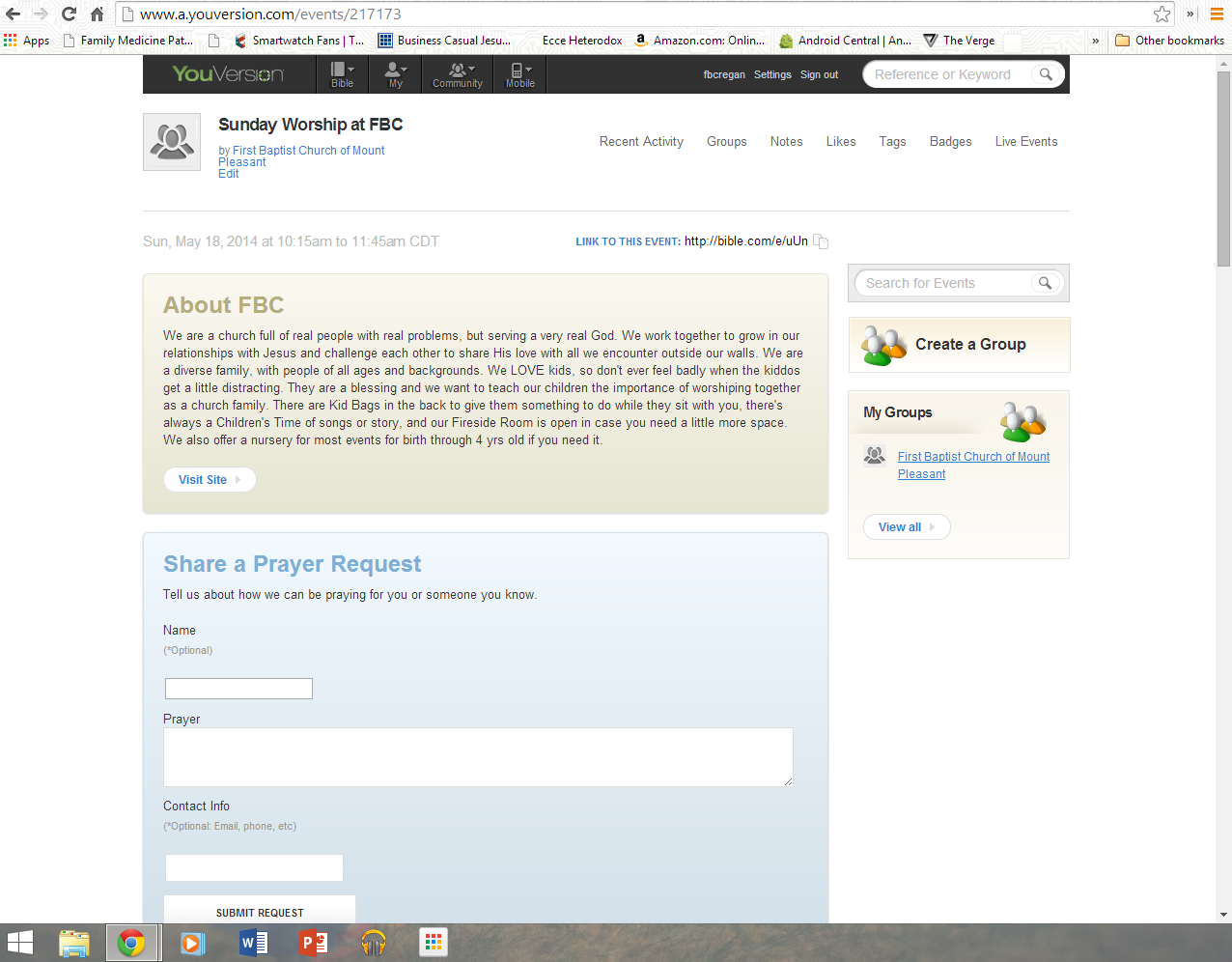
The Bible's Live Events gives a church or group the chance to let people connect through the app to take notes, read the Scripture, submit prayer requests and much more.  I don't use all the options, but each week use it for people that want to follow along with the sermon or communicate with us a need.
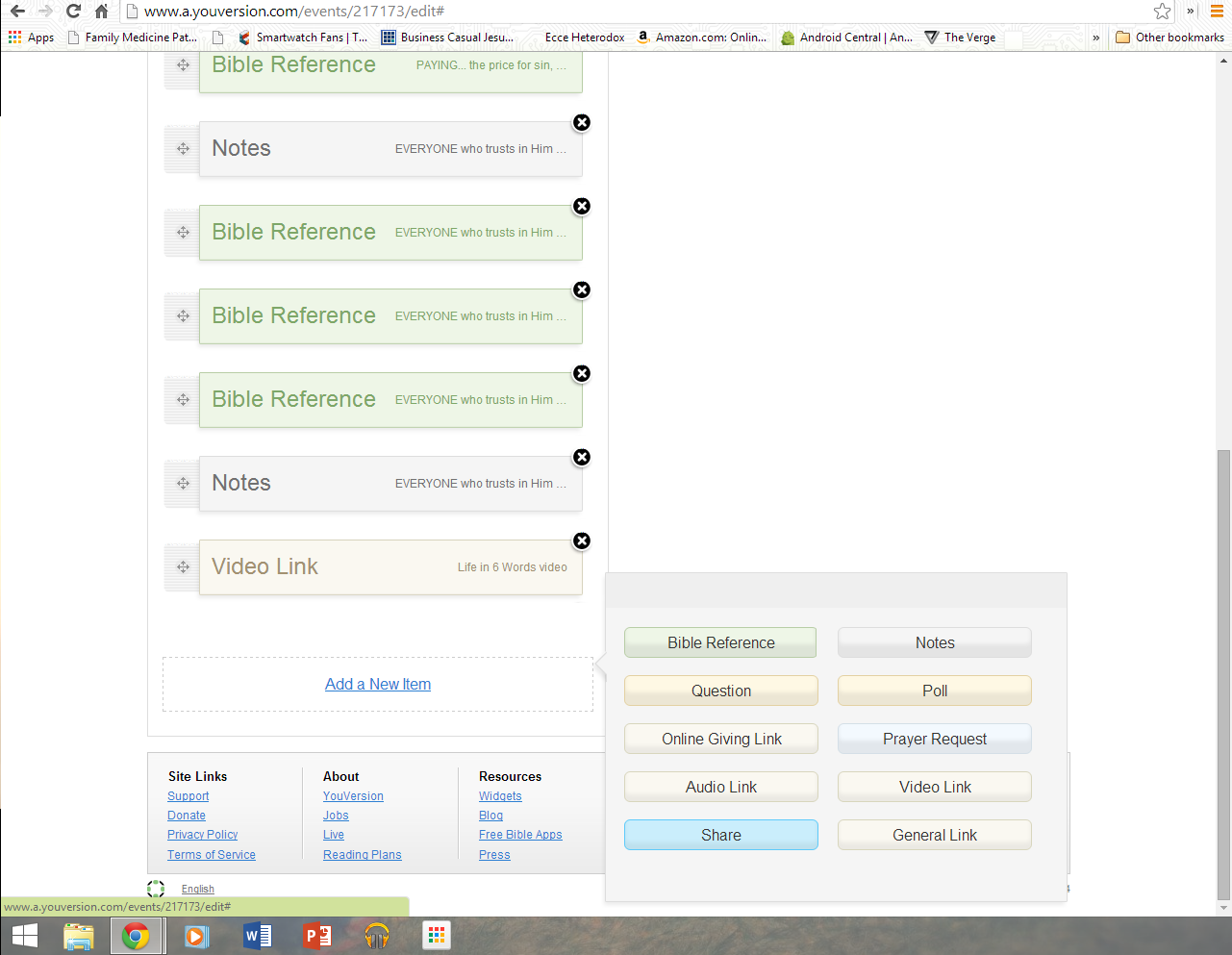

First, you can only set up a Live Event via a computer. (PC, Mac, or ChromeOS)  There is no option within the mobile app to set up or edit Live Events.  (PLEASE MAKE THAT POSSIBLE, Youversion.)  But it's quite easy within a browser to bring up my sermon notes on Google Drive and Youversion in another tab to lay out the Event.  I don't use all the options, but do some simple things.  First, our Event has some info about our church and a link to our website.  Next, there is a place to fill out prayer requests that will submit them to us.  (Though, there are no notifications that alert me to a submitted a prayer request.  I have to manually check to see if anyone has submitted any.  Another flaw.)  Then I can go through my sermon structure to put in places for notes.  For me, these are just a basic point of the sermon or questions related to it, and then there is a place for the user to input their own notes or thoughts.
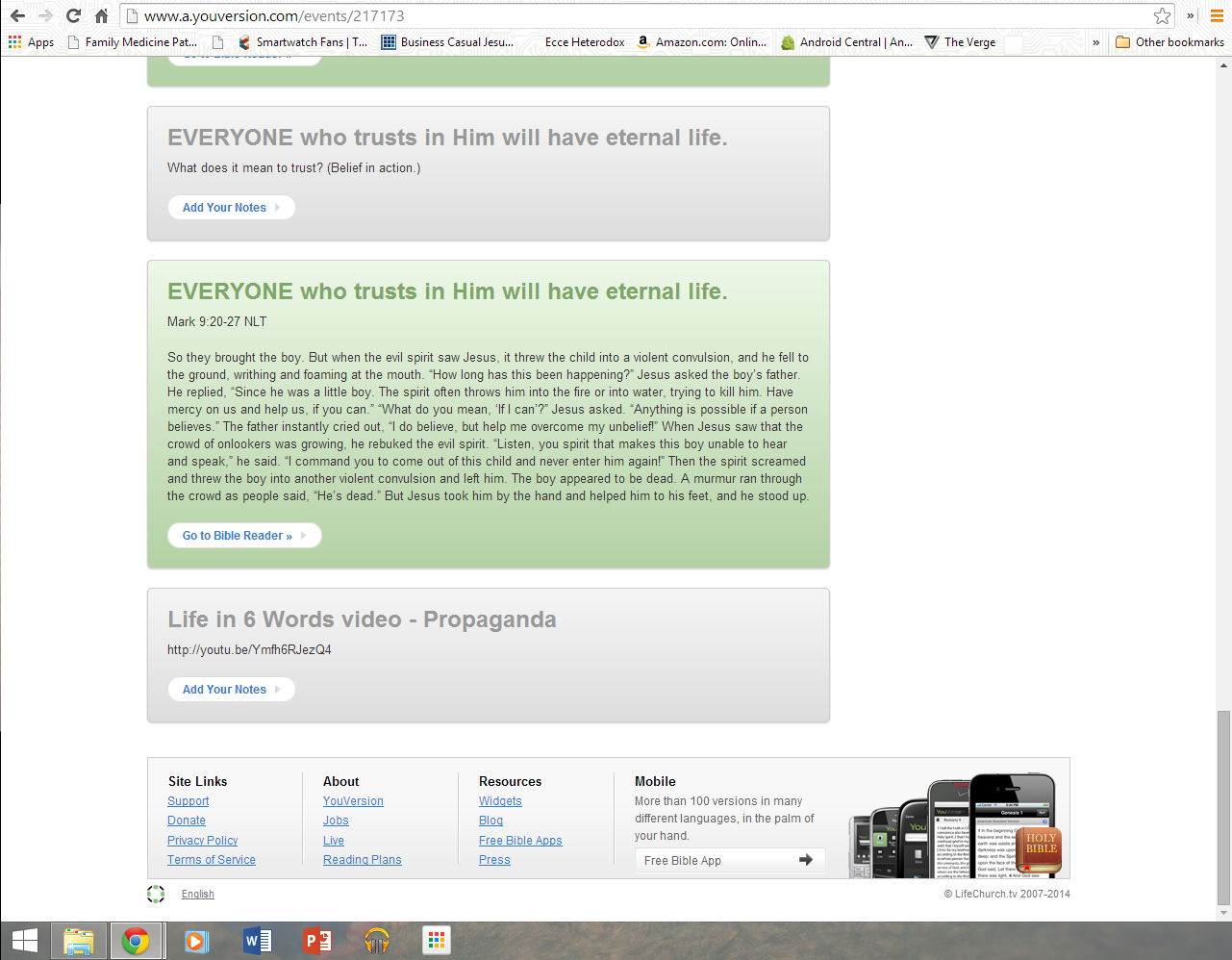

The best part, to me, is that I can put in all the exact Scripture references that I'm going through in the version I want to use.  So I'm not handcuffed to the NIV or some other version that's sitting in the pews, and users can follow along exactly with what I'm reading.

When I began using this, there was no one in our church interested in using it.  But as more and more people are buying smartphones and tablets, the interest has risen.  Now, we have many that are using it weekly.  My 7 year old son was even using it on my wife's smartphone last Sunday, even taking notes.  I've heard report after report from participants that they love using it to follow along, and love emailing themselves their notes from the event at the end of worship.

If you are interested in using this for your church, here are some requirements.  (In my opinion.)

  1. Offer free wifi in your church.  You can't invite people to use devices if they can't get online.  This means having a separate wifi network that is accessible for everyone without getting access to your sensitive administrative info.  We ran a separate router to the balcony in our sanctuary and set it up as "FBC Guest" for anyone to connect to.  And make sure it's working each week.  All it takes is a flicker of power loss in the building and the router will need reset to work correctly.  If McDonalds and Starbucks can be a wifi hotspot, so can we.
  2. Lay out specific instructions for using the app.  Many people are not good at figuring this stuff out.  We're having more of our older members getting Kindles, iPads, or Android tablets and they need instructions for getting connected.  In our bulletin it says, "If you have a smartphone or tablet there is a new way to interact with our worship services.  First, connect through our free wifi called "FBCGuest".  Then, download the Bible app by Lifechurch.tv (Youversion).  You can find it in the Appstore, Google Playstore, or Amazon Appstore.  Next, tap your menu and look for the section called "Live".  Tap 'Search for a Live Event' and it will bring up local live events.  Ours is called "Sunday Worship at FBC".  There, you can learn more about us, read Scripture, take notes, and even share prayer requests.  Check it out."
  3. Have someone available to help people who need help.  (We don't have this set up well yet, but I'm working on it.  Normally the person who would help someone with tech is me and I'm up front.)
So give it a try sometime; it just may be useful in your church.  It's not the answer to getting all people involved in worship, but for those that want to, it's a good tool.  It's not perfect, and there are things they could add to make it much more useful, but it's good at what it does.

And to users:  We're not stupid; we know when you're looking at Facebook, playing Flappy Bird, or texting instead of using the app.  Don't fool yourself.